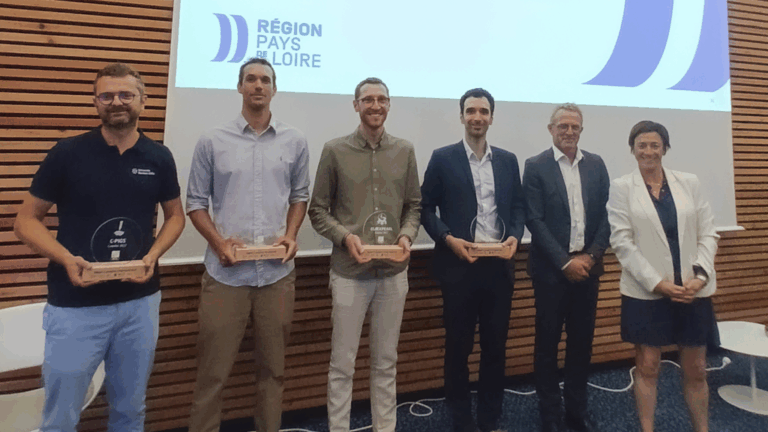
Discover the winners of the WEAMEC 2025 calls for projects
ResearchThe members of the WEAMEC jury met on Tuesday, April 29 to receive and select the 2025 winners of the “Research” and “International” Call for Projects.
Each year, WEAMEC selects research projects focused on marine renewable energy. The aim of this call for projects is to develop the region’s skills so that they remain relevant to the challenges faced by the sector and the national and international energy context.
The five projects selected are:
- [International] The BLACKPEARL project by Antoine Dubois – ISOMer (Institute for Marine Substances and Organisms). The BLACKPEARL project aims to characterize marine biocolonization of offshore structures, in particular the combined effects of algae and marine organisms on the performance of MRE devices, in order to improve hydrodynamic models and optimize their design.
- [Research] Benoit Hilloulin’s ACE project – GeM (Civil Engineering and Mechanical Engineering Research Institute). The ACE project aims to demonstrate the effectiveness and industrial feasibility of using calcifying microalgae to form a protective coating on marine concrete, in order to improve its durability against environmental damage.
- [Research] Ugo Pelay’s POLYENERGIES project – LHEEA (Laboratory for Research in Hydrodynamics, Energy and Atmospheric Environment). This project aims to design a multi-energy ocean thermal power plant in Bora Bora, capable of producing electricity, cooling, fresh water, and hydrogen, while assessing its economic and environmental viability to meet the specific challenges of tropical islands.
- [International] Matthieu Blanc’s C-PIGS project – GERS (Department of Geotechnics, Environment, Natural Hazards and Earth Sciences). This project seeks to understand how glauconite, a mineral found in marine soils, affects the installation of piles for offshore wind turbines and aims to improve installation techniques.
- [Research] Stéphanie Bonnet’s HOMER project – GeM (Civil and Mechanical Engineering Research Institute). This project aims to improve monitoring of the condition of concrete in offshore wind turbine floats, using an innovative electrical method to detect the presence of salt (chlorides), a sign of deterioration. The aim is to make this method faster and simpler, without the need for lengthy laboratory tests, particularly for more environmentally friendly (low-carbon) concrete.
We would like to thank the candidates, the jury (Centrale Nantes, Nantes University, Pôle Mer Bretagne Atlantique, Smart Power (formerly S2E2), Pôle EMC2) and our other partners (IRT Jules Verne, the Pays de la Loire Region, Nantes Métropole and Saint-Nazaire Ville & Agglo) for their time and commitment. We look forward to following the development of these new projects.
The traditional awards ceremony took place this year on Tuesday, June 24, during the Regional Sea and Coastline Assembly.
The fund used to finance this support is provided by the Pays de la Loire Region and Saint-Nazaire Agglomération.