Coordinateurs du projet
Context
Increasing the service life of wind turbines is one of the main areas of research facing wind farm operators. One cause of premature aging that is often cited is the accumulation of loads imposed by strong shear forces upstream of the rotor due to malfunctioning of the wind turbine and/or the atmosphere in which it operates.
Wind is highly variable in space and time (turbulence, gusts, etc.), while wind turbine blades are becoming increasingly longer. In order to limit the influence of these disturbances on the wind turbine, one of the solutions currently being considered is what is known as “retrofitting” or the integration of adjustment systems commonly referred to as “ADD-ON”. This consists of modifying the aerodynamic surface of the blade after the fact to improve its performance and service life.
Scientific breakthroughs and innovation
Active systems for dynamic adaptation of blade aerodynamics.
The ASAPe project proposes the development of a series of original, robust, and simple ADD-ON systems, consisting of Epenon and/or wireless pressure sensors and pulsed jet-type fluidic actuators, capable of dynamically adapting the aerodynamics of wind turbine blades and thus reducing aerodynamic loads.
This system will be gradually brought to maturity through tests on a two-dimensional blade profile in the LHEEA aerodynamic wind tunnel (intermediate-scale gusts) and in the CSTB’s Jules Verne wind tunnel (fluctuating wind at scale 1). At full scale, a real blade profile will be provided by the manufacturers who have signed letters of support (VALOREM and EDF-EN service). Prospective work will also be carried out in the ASAPe project to prepare for on-site testing (choice of site, wind turbine, position and control strategy, etc.).
Expected technical and economic impact
New active add-on systems that can be used on wind turbine blades.
Demonstrator
Demonstration of the Add-on’s operation in a small-scale wind tunnel (January 2020) and at full scale (January 2021).
This ASAPe project will be carried out using equipment acquired as part of the ROTOR-OPTIM project.
Results
The wind tunnel was equipped with a chopper as part of the WEAMEC ROTOR OPTIM project. It is capable of producing a wide and rapid speed fluctuation that also contains turbulence. Studies conducted as part of ASAPE have made it possible to vary the intensity, spatial extent, and duration of a gust using the position of the obstacle (2D blade profile) in the test vein, the blockage, and the rotation frequency of the system, respectively.
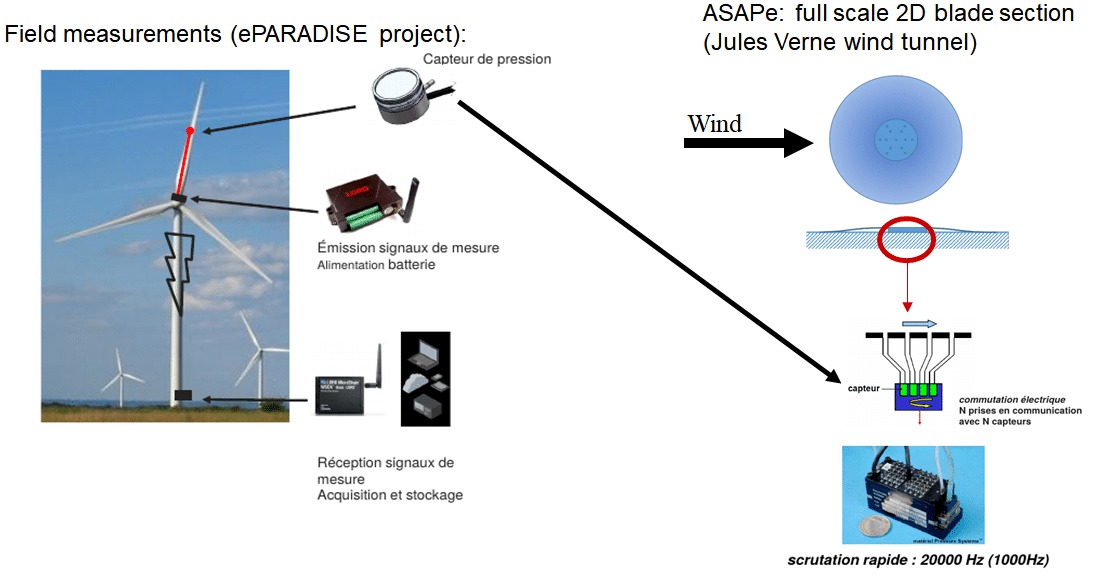
Thanks to small-scale and full-scale wind tunnel tests, full-scale ePenons are currently being installed on existing blades as part of the ePARADISE project.
An initial control loop has been simulated based on small-scale wind tunnel experiments. It uses global sensors (aerodynamic balance), local actuators, and the “chopper” to disrupt the flow. A closed-loop flow control demonstrator was thus implemented with the development of several control laws (without model, super-twisting model). The control allows the tracking of a non-gust lift setpoint that is robust to the passage of a gust reproduced in the wind tunnel, the “chopper” developed in the ROTOR OPTIM project. A summary of these encouraging initial results has been submitted for the TORQUE 2022 conference.
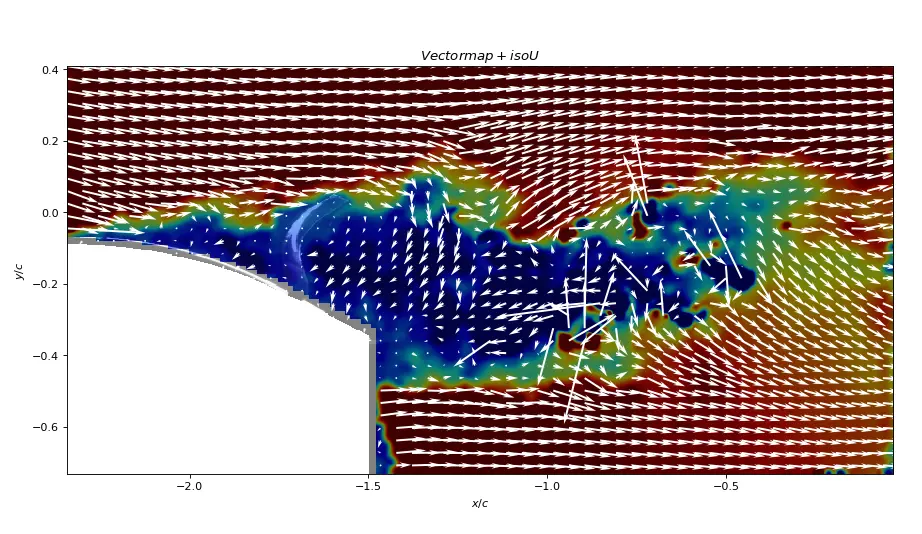
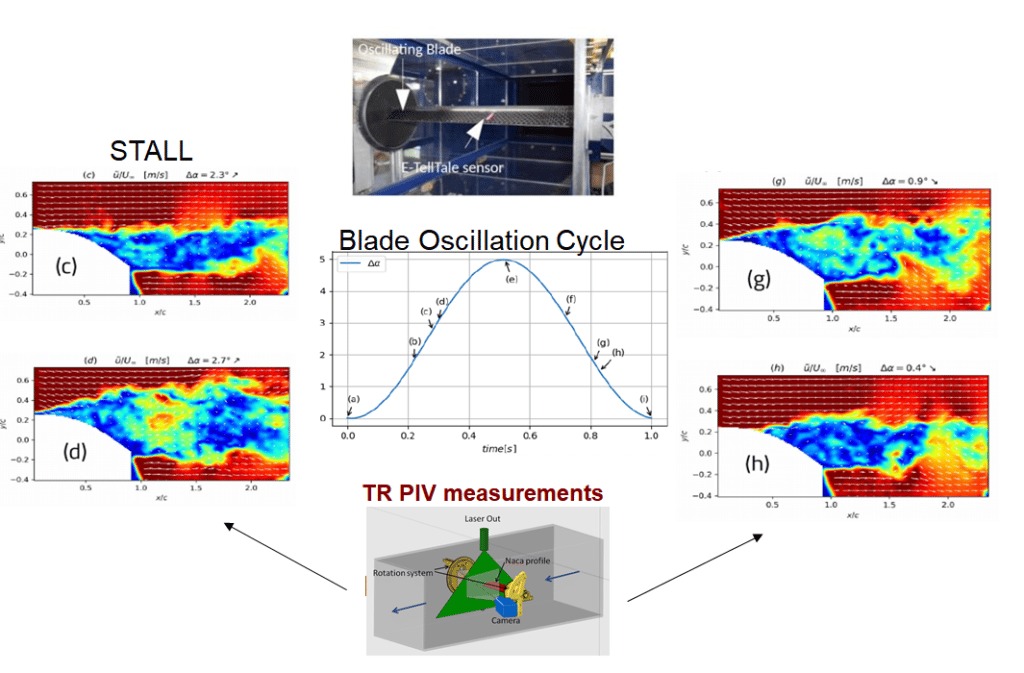
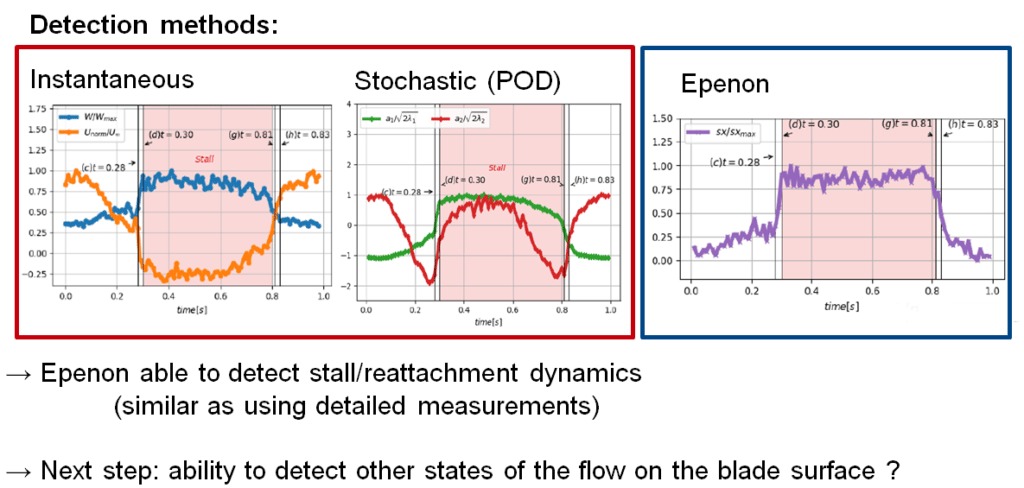
The ePenons sensors were tested at full scale in the CSTB wind tunnel. The model, manufactured from a scan of the blade, was first characterized, then the ePenons sensors were added. Static tests (static angle of incidence changes) show that the sensor signal correlates with the position of the flow separation point on the profile.
Furthermore, it was shown that a single e-penon sensor on the trailing edge of the 2D blade section is sufficient, instead of 78 pressure sensors around the chord.
Full-scale tests in the CSTB wind tunnel made it possible to measure and highlight an unstable separation phenomenon.
ePenon aerodynamic sensors were installed at the Saint-Hilaire de Chaléons site (Pays-de-Loire, France) as part of the ePARADISE project in April 2021.
Characterization of flow behind chopper blade:
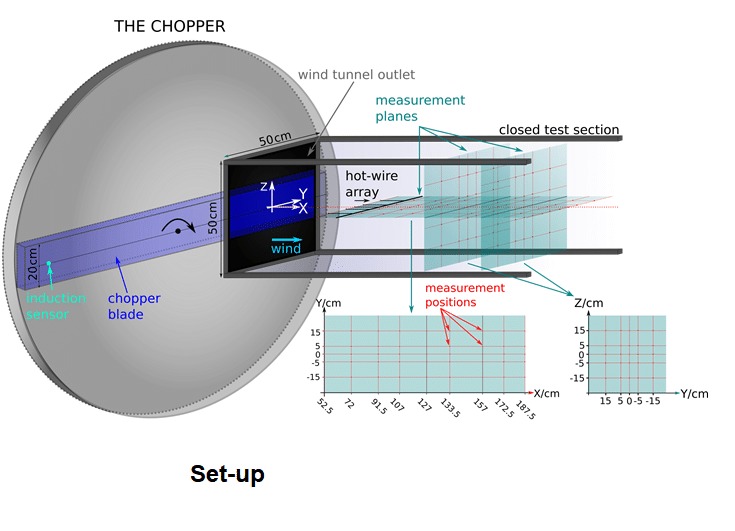
Main findings are gust scaling parameters:
- downstream position
- blade width
- rotational frequency
Ability eTellTale to detect flow features:
Wireless pressure sensors (CSTB)
Following the ASAPe project, and based on its results, TWO new projects have emerged:
- ePARADISE Project (Evaluation of Aerodynamic Disturbances on Blades for the Improvement of Wind Turbine Durability and Noise Impact)
- Projet MOMENTA
Publications and conferences with proceedings
- I. Neunaber & C. Braud, First characterization of a new perturbation system for gust generation: the chopper Wind Energ. Sci., 5, 759–773, 2020
- Soulier, A., Braud, C., Voisin, D., and Podvin, B.: Low-Reynolds-number investigations on the ability of the strip of e-TellTale sensor to detect the flow features over wind turbine blade section: flow stall and reattachment dynamics, Wind Energ. Sci., 6, 409–426, https://doi.org/10.5194/wes-6-409-2021, 2021
- I. Neunaber & C. Braud, Aerodynamic behavior of an airfoil under extreme wind conditions, Journal of Physics: Conference Series, Volume 1618-The Science of Making Torque from Wind (TORQUE 2020), 22 September 2020
- I. Neunaber, F. Danbon, A. Soulier, D. Voisin, E. Guilmineau, P. Delpech, S. Courtine,C. Taymans & C. Braud. Wind tunnel study on natural instability of the normal force on a full‐scale wind turbine blade section at Reynolds number 4.7 · 10. Wind Energy. 25. 2022. 10.1002/we.2732.
- A. Soulier, C. Braud , D. Voisin, F. Danbon, High-Reynolds-number investigations on the ability of the full-scale e-TellTale sensor to detect flow separation on a wind turbine blade section. Wind Energy Science. 7. 2022. 1043-1052. 10.5194/wes-7-1043-2022.
- I. Neunaber, E. Guilmineau, F. Danbon, P. Delpech, S. Courtine, D. Lenoir, A. Soulier, D. Voisin, C. Taymans, C. Braud, Observation of a natural spatio-temporal bi-stability on a full scale blade section at pre-stall angles of incidence, Short communication in Wind Energy, en préparation.
- I. Neunaber, A. Soulier, D. Voisin, F. Danbon, F. Delpech, D. Lenoir, C. Taymans, C. Braud, Testing aerodynamic sensors on a full-scale wind turbine blade, WES, en préparation.
- R. Mishra, I. Neunaber, E. Guilmineau, C. Braud, « Adapting turbulent inflows to bypass low Reynolds number effects on 2d blade sections » abstract submitted to the international conference TORQUE 2022.
- L. Michel, I. Neunaber, R. Mishra, C. Braud, F. Plestan, X. Boucher, JP. Barbot, C. Join, M. Fliess « model-free control of the dynamic lift on a wind turbine blade section based on an active flow control device » abstract
submitted to the international conference TORQUE 2022.
Oral presentations
- Soulier, C. Braud, D Voisin, F Dandon, V Jaunet, JJ Lasserre et P Galtier., Electronique Tell-Tale, a sensor to detect flow separation on wind turbine blades, SMARTEOLE colloquium, PRISME, Orléans, France, 2018
- Sandrine AUBRUN, Caroline BRAUD, Boris CONAN, Benyamin SCHLIFFKE (Centrale Nantes), Examples of wind-turbineoriented aerodynamic challenges, French American Innovation Day 2019, March 18-19 – Télécharger la présentation complète
- Soulier, A., Braud, C., Voisin, D., and Podvin, B., Ability of the e-TellTale sensor to detect flow features over wind turbine blades: flow stall/reattachment dynamics, Wind Energ. Sci. Discuss., 2020.
Organization of a mini-symposium at the Wind Energy Science Conference, 2019: “Active Flow Control on Blades”
14 participants: Seimens-Gamesa, TUDelft, Forwind, DLR, DTU, ECN.TNO, Univ. Waterloo, IRPHE(FR), AIST (J), Scalian(FR), Mer Agitée(FR), LAAS(FR), LHEEA(FR), Orléans(FR).
Including 2 oral presentations at this mini-symposium:
- Ingrid Neunaber, Caroline Braud, Antoine Soulier and Sandrine Aubrun (LHEEA – Ecole Centrale Nantes, CNRS), Characterization of a new perturbation system for gust generation: The Chopper, Wind Energy Science Conference, 2019, Cork, Irland. 18 juin 2019
- A. Soulier, C. Braud, D. Voisin, B. Podvin, et al, Ability eTellTale to detect flow features, Wind Energy Science Conference, Cork, Irland, 2019
Organization of a mini-symposium at the Wind Energy Science Conference, 2021 on “Smart Blade Technologies”
with IWES, FORWIND, AIST, TU-Delft, and DLR: ~10 participants from international laboratories (IWES, TU-Delft, DLR, ForWind, AIST, etc.)
Including 3 oral presentations in this mini-symposium:
- C. Braud, I. Neunaber, F. Danbon, P. Delpech, D. Lenoir, E. Mornet, Y. Queveau, A. Soulier, D. Voisin, C. Taymans Wind tunnel full scale aerodynamic sensors assessment prior to field tests – Wind Energy Science Conference, On-line to dueCOVID-19, organisation : Forwind – Hannover, May 2021.
Conference, On-line to due COVID-19, organisation : Forwind – Hannover, May 2021. - A. Soulier, D. Voisin, I. Neunaber, C. Braud, F. Danbon, P. Delpech, E. Mornet, Y. Queveau Flow separation detection performance of the e-Telltale evaluation at full scale – Wind Energy Science Conference, On-line to dueCOVID-19, organisation : Forwind – Hannover, May 2021.
- I. Neunaber, C. Braud, E. Guilmineau, F. Danbon, P. Delpech, A. Soulier, D. Voisin, C. Taymans High Reynolds number blade aerodynamics : 3D flow separation dynamics – Wind Energy Science Conference, On-line to due COVID-19, organisation : Forwind – Hannover, May 2021.