Coordinateurs du projet
Context
Prospective studies on the installation of offshore wind farms use engineering models to consider the interactions between wind turbines. The representation obtained of these phenomena remains incomplete, even though there are significant challenges associated with this configuration. In particular, the wind observed at turbines located in the wake of other wind turbines is significantly disturbed.
The ATMOSFARM project is a logical continuation of the WEAMEC ECOSFARM project. During the ECOSFARM project, a coupling was created between the Navier-Stokes Grid-flow solver (formerly WCCH) and the FAST wind turbine simulation tool. The resulting tool provides a detailed representation of the flows within a wind farm. A proof of concept was carried out on a small scale, where very promising results were obtained. However, before wind farms can be simulated under real conditions, it is necessary to take into account a realistic distribution of wind and its evolution within the farm.
During the ATMOSFARM project, Grid-flow will be optimized and interfaced with the NCAR LES code. This coupling will enable the simulation of different atmospheric environments. When used with FAST, full-scale wind farm simulations can be performed. The developments made as part of this project will improve the performance of the Grid-flow/FAST coupling and represent a further step forward for CFD simulation of full-scale wind farms.
Scientific breakthroughs and innovation
Only five other codes have been identified as offering levels of accuracy and optimization similar to those offered by the Grid-flow/FAST coupling. The advantage of Grid-flow/FAST lies in the flexibility it offers for setting up simulations and setting simulated bodies in motion. This second point offers significant potential for simulating floating wind turbines, which could be the subject of a future project.
Expected technical and economic impact
The developments planned as part of the ATMOSFARM project should result in a simulator capable of accurately simulating interactions between wind turbines on a real scale. The developments will be commercialized via NextFlow Software, which distributes Grid-flow.
Demonstrator
The ATMOSFARM project is based on the Grid-flow/FAST coupling developed as part of the ECOSFARM project, which has proven the ability of this tool to simulate wake interactions between wind turbines at full scale.
Results
December 2021
Over the past six months, work has focused on getting to grips with and optimizing the Gridflow/FAST coupling.
- A system for resuming calculations in progress has been set up, which is necessary for large-scale simulations.
- The simulations have been optimized at various points.
- The post-processing systems have been parallelized.
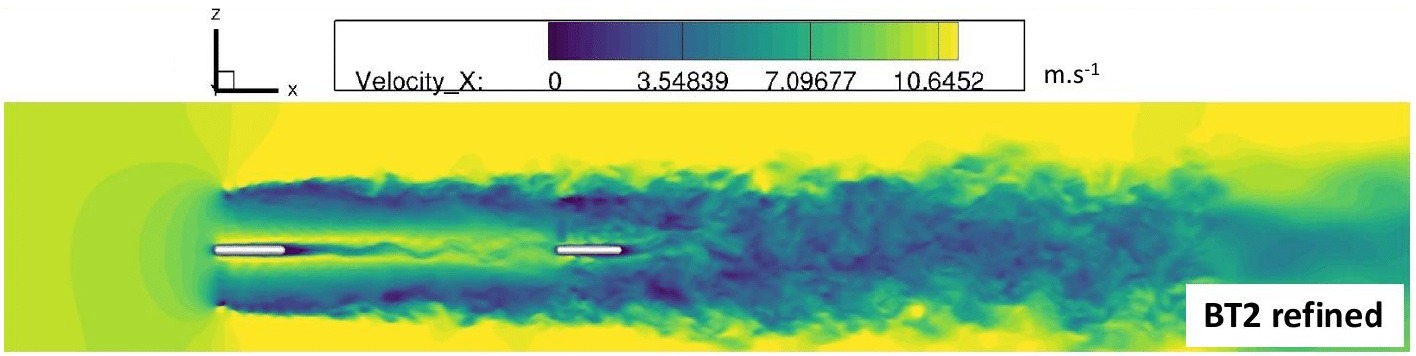
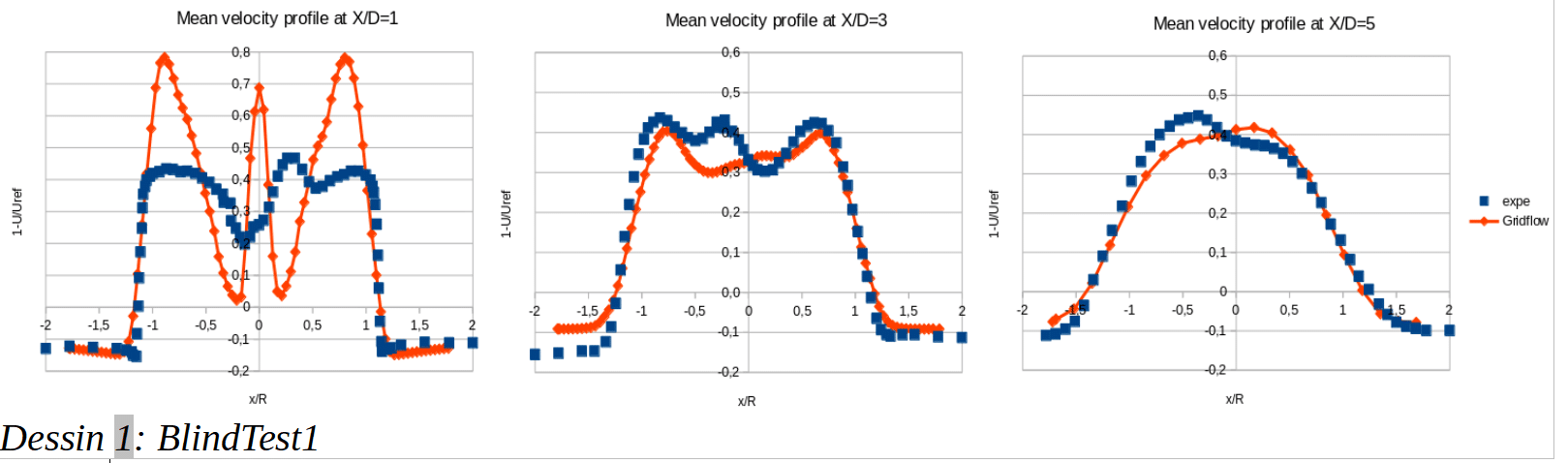
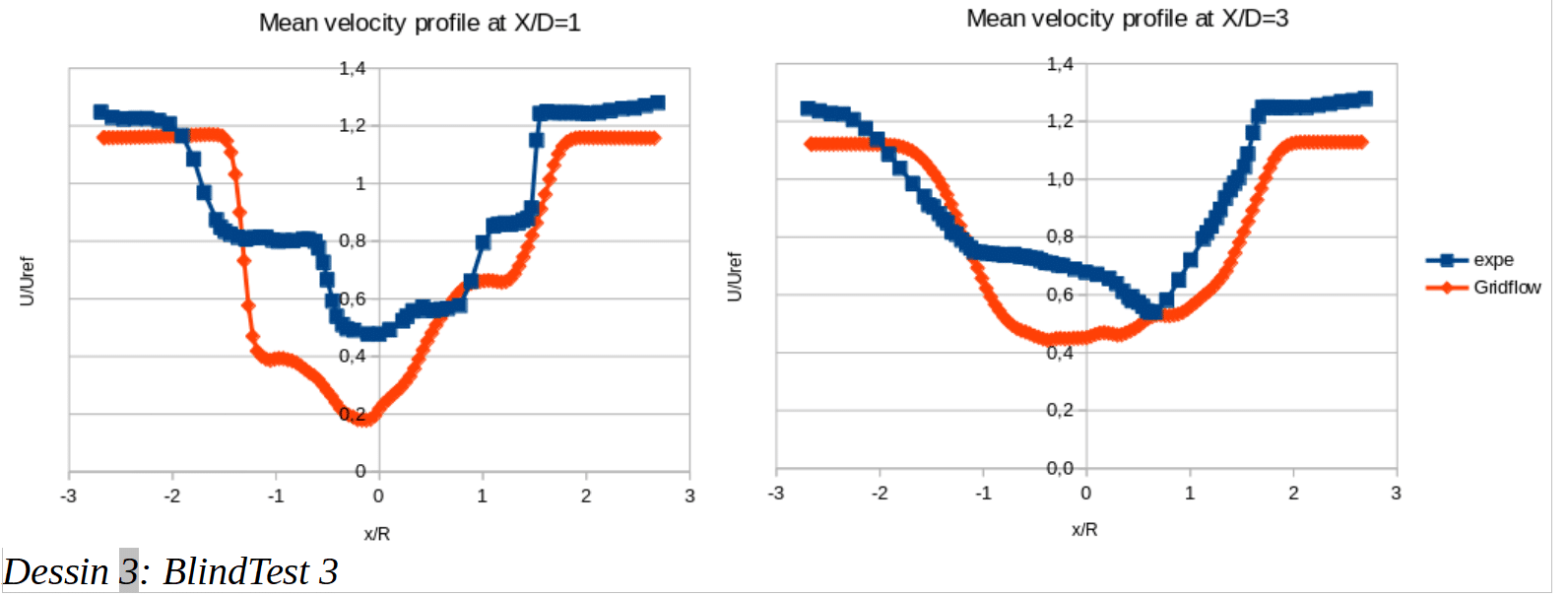
Following these developments, validation was carried out on small-scale academic cases. The BlindTest version 1 (Krogstad et al, 2013), 2 (Pierella et al, 2014) and 3 (Krogstad et al, 2015) cases, which provide experimental data from wind turbines in wind tunnels, were used.
- The results obtained in BlindTest 1 showed good accuracy when moving away from the wind turbine. The results obtained in the near wake remain disturbed due to the use of an Actuator Line method.
- The results obtained in BlindTest 2 show satisfactory accuracy. There has also been an improvement in the quality of the results compared to those obtained during the ATMOSFARM project. These differences can be explained by improvements to the Gridflow resolution scheme and the correction of bugs in the Gridflow/FAST coupling.

- The preliminary results obtained in BlindTest 3 show significant deviations from the experimental results. Work is underway to improve the consideration of interactions between wind turbines.
Comparisons have also been made to measure the influence of gradient reconstruction schemes.
The last point concerns the transition to a purely implicit temporal scheme. Preliminary work to adapt this scheme to the Gridflow/FAST coupling context is underway.
Perspectives
The implementation of a tool for simulating the atmospheric boundary layer removes the final barrier to moving on to simulating multiple wind turbines at full scale. Future developments could focus on simulating floating wind turbines.