Coordinateurs du projet
Context
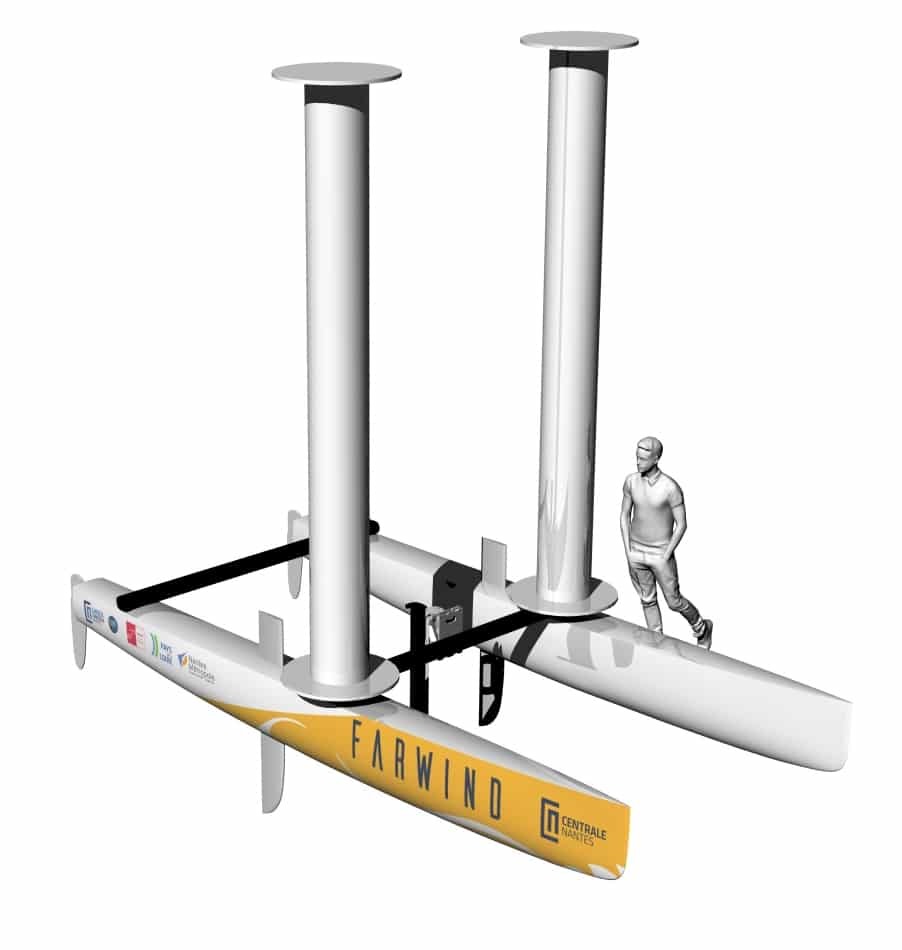
Since 2016, LHEEA has been studying a disruptive concept for producing renewable fuel from offshore wind resources. This concept is the FARWIND energy system. It consists of two key subsystems:
- Fleets of autonomous wind ships (FARWINDERs). Wind ships are sailing ships that generate electricity using turbines placed under their hulls [Platzer & Sarigul-Klijn, 2009]. The electricity produced is converted into renewable fuel by an on-board electricity-to-liquid conversion plant (CEL). The route taken by the fleets of ships is optimized by weather routing in order to maximize production.
- Tankers dedicated to fleet logistics. The fleets are escorted by dedicated tankers, whose main function is to collect the fuel produced and supply the FARWINDERs with the raw material (CO2) for the CEL plant. Unlike the FARWINDERs, the tankers are not autonomous. They also perform protection, surveillance, and maintenance functions.
The results obtained at LHEEA indicate that a nominal power of 1 to 2 MW is feasible for FARWINDERs [Gilloteaux & Babarit, 2017], and that meteorological routing would enable load factors of over 80% to be achieved [Abd-Jamil et al., 2019]. These results are particularly promising for the eventual production of fuel at a competitive cost [Babarit et al., 2018; Fasihi & Bogdanov, 2016].
Scientific breakthroughs and innovation
A key aspect in ensuring the economic viability of the FARWIND system is that the FARWINDERs are autonomous (in order to minimize operating costs). The associated challenge is the development of algorithms and control systems that enable safe and efficient navigation of the FARWINDERs in a fleet. These control systems differ from existing systems in that they are closely intertwined with the energy production system, one of the key adjustment parameters being the rotation speed of the tidal turbine.

The AUTOFLEET_PLUS project is a continuation of this effort. It will improve the representativeness of the platform and develop algorithms to optimize energy production.
In order to improve the controllability of the platform (WEREVER_DEMO_PLATFORM developed as part of the AUTOFLEET_Y1 project) and its representativeness in relation to the design envisaged by FARWIND ENERGY, it seems appropriate to:
- Equip the platform with two rotors rather than just one, as envisaged in the AUTOFLEET_Y1 project.
- Develop and test an MPPT (Maximum Power Point Tracking) algorithm to automatically determine the operating points for the hydrogenerator and rotors.
Results
Development of a dynamic model of the platform.
This model will enable the algorithms developed in the project to be fine-tuned in a virtual environment before they are implemented on the platform. The model is based on a system approach. It is 3D. It incorporates models for the rotors, the hull, the hydrogenerator, and the rudders.
Manufacture of an improved Flettner rotor.

The first result of the project is a second Flettner rotor for the AUTOFLEET prototype (Figure 1). The improvements of this second rotor compared to the first rotor are:
- Lightness: -10% compared to the first rotor
- Rigidity: the first vibration mode of this second rotor is outside the engine’s operating ranges, unlike the first rotor.
- Aerodynamics: removal of the intermediate flange.
Development of a dynamic model of the platform.

This model will enable the algorithms developed in the project to be fine-tuned in a virtual environment before their implementation on the platform. The model is based on a system approach. It has 3 degrees of freedom. It incorporates models for the rotors, the hull, the hydrogenerator, and the rudders.
Publications and presentations produced
Elie B. , Bognet B. , Boileau T.,Weber M. ,Gilloteaux J-C. ,Babarit A. , 2022. Experimental proof-of-concept of an energy ship propelled by a Flettner rotor, Journal of Physics : conference series 2265 042057