Coordinateurs du projet
Context
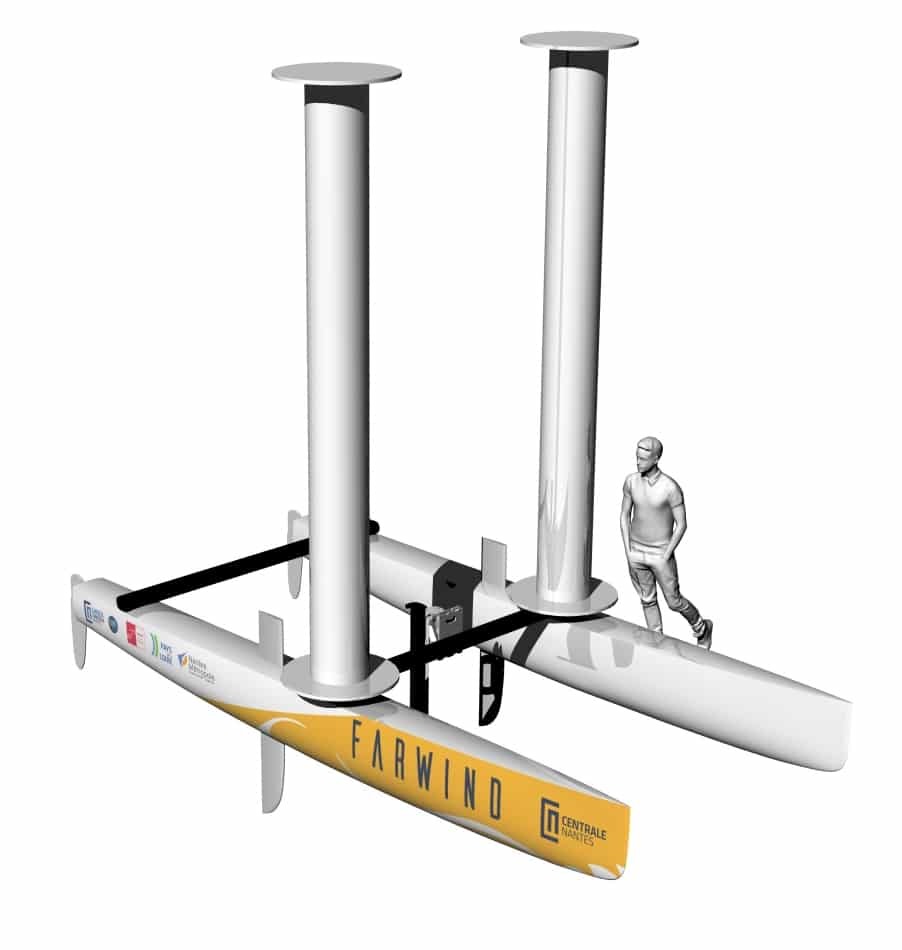
Since 2016, LHEEA has been studying a disruptive concept for producing renewable fuel from offshore wind resources. This concept is the FARWIND energy system. It consists of two key subsystems:
- Fleets of autonomous wind ships (FARWINDERs). Wind ships are sailing ships that generate electricity using turbines placed under their hulls [Platzer & Sarigul-Klijn, 2009]. The electricity produced is converted into renewable fuel by an on-board electricity-to-liquid conversion plant (CEL). The route taken by the fleets of ships is optimized by weather routing in order to maximize production.
- Tankers dedicated to fleet logistics. The fleets are escorted by dedicated tankers, whose main function is to collect the fuel produced and supply the FARWINDERs with the raw material (CO2) for the CEL plant. Unlike the FARWINDERs, the tankers are not autonomous. They also perform protection, surveillance, and maintenance functions.
The results obtained at LHEEA indicate that a nominal power of 1 to 2 MW is feasible for FARWINDERs [Gilloteaux & Babarit, 2017], and that meteorological routing would enable load factors of over 80% to be achieved [Abd-Jamil et al., 2019]. These results are particularly promising for the eventual production of fuel at a competitive cost [Babarit et al., 2018; Fasihi & Bogdanov, 2016].
Scientific breakthroughs and innovation
A key aspect in ensuring the economic viability of the FARWIND system is that FARWINDERs are autonomous (in order to minimize operating costs). The associated challenge is the development of algorithms and control systems that enable safe and efficient navigation of FARWINDERs in a fleet. In relation to this challenge, the objectives of the AUTOFLEET_Y1 project are to develop and validate algorithms and control systems for trajectory tracking by a FARWINDER (rudder and aerodynamic force control) while maximizing energy production.

Expected technical and economic impact
The experimental platform developed in the AUTOFLEET project will constitute a new research platform for LHEEA. It will therefore be available for rent to researchers or manufacturers wishing to conduct tests, for example on new control algorithms. To promote it, a web page will be created on the LHEEA website.
The strategy for the algorithms and control systems developed in the project is open source. We believe this strategy is the most appropriate given the challenge of establishing the credibility of FARWIND technology. The aim of making the results open source is to facilitate their dissemination and raise awareness of the feasibility and opportunities of offshore wind power.
Finally, it should be noted that the strategy for promoting the work carried out as part of the FARWIND meta-project, of which AUTOFLEET is a part, involves the creation of a start-up to bring the technology to market once TRL 4 is reached (2020/2021). The work carried out in AUTOFLEET will also be promoted industrially in this context.
Results
Results obtained in the first half of the year in the AUTOFLEET #1 project
- Qualification of the Watt&Sea hydrogenerator in a towing tank

- Rotor design principle

Results obtained in the second and third quarters of the AUTOFLEET #1 project
Completion of the experimental assembly

Manufacture of the rotor tube (carbon fiber and foam sandwich)

Development of the interface between the hull and the rotor

Creation of the on-board energy control and management system
Tests on the Erdre (April 2021)

Video of the tests:
The main result of the project is an operational prototype enabling the development and validation of energy-powered vessel control algorithms (Figure 1).
This prototype consists of:
- A 5.5 m long catamaran hull (Hobie Cat Tiger)
- A Flettner rotor 2.7 m high and 0.45 m in diameter for propulsion.
- A 600W Watt&Sea hydrogenerator. This generator can be equipped with a 200 or 240 mm propeller.
- A control and acquisition system enabling remote operation of the vessel.
In collaboration with FARWIND ENERGY, this platform was tested in July 2021 on Lake Vioreau (Loire-Atlantique). These tests provided experimental proof of concept for the operating principle of a ship powered by a Flettner rotor (a world first).