Coordinateurs du projet

Context
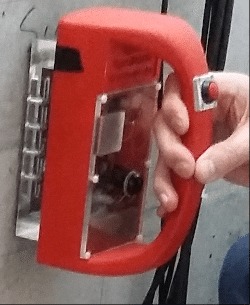
Capacitive probe – © IFSTTAR
(outputs), which until now have been validated by destructive testing, could be replaced by results obtained using non-destructive testing (NDT) methods.
One of the causes of deterioration in reinforced concrete structures in marine environments (such as offshore wind turbine floats or quays) is the corrosion of metal reinforcements due to the penetration of chlorides from seawater.
Non-Destructive Testing (NDT) methods, based on wave propagation (ultrasonic, electrical, and electromagnetic), are increasingly used to inspect engineering structures. The development of these techniques for monitoring offshore structures is particularly relevant since core sampling in marine environments is both difficult and costly, whereas NDT would reduce the number of cores needed to map a structure. The results of these methods are called “observables.”
Scientific breakthroughs and innovation
The long-term goal is to use END results directly in water and aggressive agent penetration models to predict, in the case of offshore wind turbines, the deterioration of concrete floats.
Expected technical and economic impact
The CA2M-COM project aims to develop NDT inspection of reinforced concrete structures in marine environments, diagnosis and prognosis of their service life for maintenance purposes.
Results
Khodor El Achrafi completed a master’s internship at IFSTTAR’s LAMES/MAST laboratory. First, he built a database containing the formulations, test conditions, and results of destructive and non-destructive tests available for laboratory tests carried out as part of the ORSI-APOS project. He implemented the Tang and Nilsson model for chloride diffusion penetration in saturated concrete and analyzed the indicators resulting from adjustments to the profiles obtained using destructive and non-destructive methods. He demonstrated the value of NDT profiles, particularly for observing changes in the diffusion coefficient over time. He then supplemented his database with all the destructive and non-destructive tests carried out in 2007 on four reinforced concrete beams from the GPM-NSN. He used the results and the model to predict the evolution of penetrations in 2018, then proposed a complementary destructive and non-destructive (NDT) inspection program to be applied to these reinforced concrete structures located in tidal zones.