Coordinateurs du projet
Context
The context of this project is as follows:
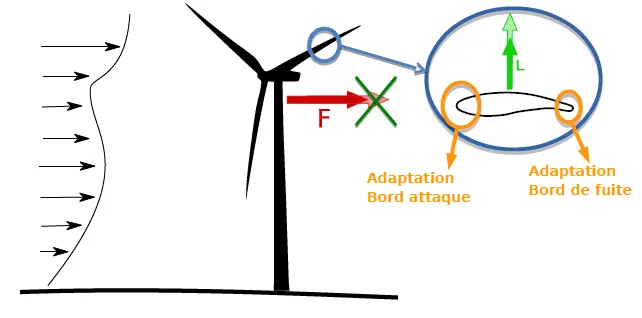
- The lifespan and production of wind turbines is reduced due to the highly unstable environment in which they operate (atmospheric turbulence, squalls, hurricanes, etc.) and their functioning (misalignments, mast passage, etc.).
- Sensors: blade measurements do not sufficiently take into account the state of the flow on the aerodynamic surface (attached/detached flow, laminar, turbulent, etc.), which is essential for determining a control action.
- Actuators: passive add-on actuators exist (vortex generators) but operate continuously and in the same way, whereas the upstream flow is highly unsteady.
- Aerodynamic wind tunnels: aerodynamic wind tunnels that take hydraulic disturbances into account are generally too expensive for small SMEs wishing to develop actuators/sensors for blades.
Scientific breakthroughs and innovation
- Wireless unsteady pressure sensors
- E-penon sensors for separation detection
- Active rather than passive actuator
- Active add-on, still unprecedented
- Add-on pre-testing on blades in an aerodynamic wind tunnel with intermediate-scale disturbance (low cost)
Expected technical and economic impact
- Improvement of the aerodynamics of existing blades using an active add-on (envelope comprising a pair of dynamic actuators/sensors that can be adjusted on the blade).
- Initial validation of the add-on comprising a LHEEA pulsed jet actuator and a MerAgitée “Epenon” sensor in the LHEEA wind tunnel (intermediate scale)
- Initial validation of the use of unsteady wireless pressure measurement that can be integrated into the add-on at scale 1 under degraded conditions, in the CSTB climate wind tunnel.
- Development of a dynamic air disturbance system in the LHEEA wind tunnel to closely replicate realistic atmospheric conditions upstream of a rotor.
- Some of the equipment components can be used in the short term to carry out assessments for MRE operators (E-penon type boundary layer separation sensors, wireless wall pressure measurement, LHEEA aerodynamic wind tunnel with disturbance for sensor/actuator testing).
In the short term, the complete system will therefore be used primarily for research activities. Subsequently, we hope to integrate this system into a research/innovation project with the aim of raising its TRL.
Demonstrator
- “Add-on” used in a closed loop at intermediate scale (LHEEA aerodynamic wind tunnel)
- Full-scale wireless unsteady pressure sensors (CSTB climate wind tunnel)
Results
NEW DISTURBANCE SYSTEM – “CHOPPER”

Disturbance system at the inlet of the LHEEA wind tunnel


HIGH SPEED PIV MEASUREMENT CAMPAIGN

LHEEA aerodynamic wind tunnel

Velocity fields from high-speed PIV measurements
E-PENON SENSOR

Static response of the sensor

Evaluation of the dynamic response of the e-penon
PULSED JETS

Aerodynamic load oscillation control

Add-ons created by Mer Agitée
Publications and presentations produced
Oral presentations
- Aerodynamics optimization study on a rigid 2D wing sail in a wind tunnel. Danbon F., Voisin, D. Desjoyeaux, M. , The 5 rd High Performance Yacht Design Conference, March 9 th -11 th , Auckland, New-Zeland, 2015
- Dynamics of lift controlled wind turbine blade. Jaunet V. , Braud C., Guilmineau E. and D. Paucelle. Wind Energy Science Conference, June, DTU (Danemark), 2017
- Dynamics of a pre-stalled windturbine blade using control of circulation at the trailing-edge. Jaunet V. and Braud C. CFM, Lille, France, 2017
- Electronic TellTale (E – penon) sensor to detect flow separation on wind-turbine’s blades. Soulier A., D. Voisin, F. Danbon, C. Braud, Wind Energy Science Conference, June , DTU (Danemark), 2017
- Examples of wind-turbineoriented aerodynamic challenges, Sandrine AUBRUN, Caroline BRAUD, Boris CONAN, Benyamin SCHLIFFKE (Centrale Nantes), French American Innovation Day 2019, Boston, March 18-19
Perspectives
This new equipment is quite versatile and can be used on various projects involving the foundations of offshore energy production structures. It complements a whole range of equipment developed since 1985, particularly for offshore applications, based on the geotechnical centrifuge.
This device will undoubtedly make it easier to explore the behavior of anchors, particularly shared anchors.
Industrial benefits
- Add-on components available for commercialization at the end of the project: wireless pressure sensors and E-penon
- Aerodynamic wind tunnel with airflow disturbances available at LHEEA for testing sensors/actuators on blades prior to full-scale testing at CSTB.
- Complete add-on still in R&D for this project.
Product Patents
Brevet EU N° EP2185942 -Brevet US N° 12/675 565