Coordinateurs du projet



Context
Grouted connections are a widely used technique in the offshore industry, particularly for foundations in the oil and gas sector. They involve a high-performance cement joint that connects two concentric steel cylinders.
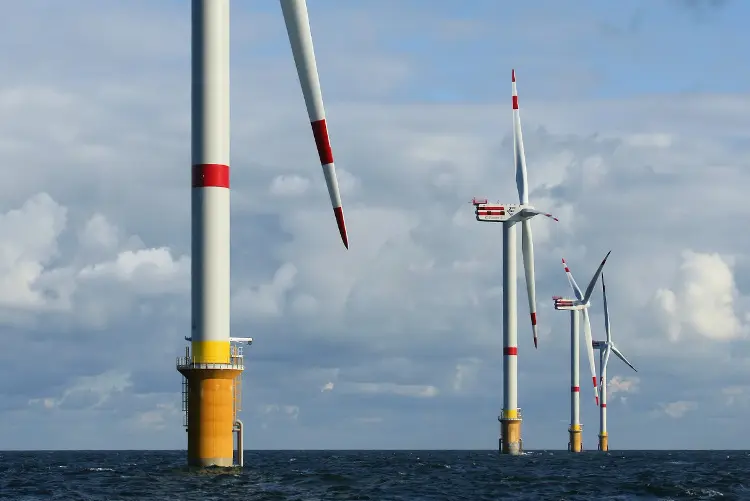
This technique has been adopted in the offshore wind sector to connect the wind turbine structure to its foundation. Depending on the type of foundation, the joint is located either between the tower and the submerged structure of the wind turbine in the case of a monopile foundation, or between the submerged structure and the foundation pile in the case of a jacket or tripod foundation. However, the dynamic forces exerted on the wind turbine are very different from those found on offshore platforms. Indeed, the grout joint currently presents a challenge for offshore wind farm developers. In 2009-2010, a gradual slippage of the connection was observed on nearly 600 of the 988 offshore wind turbines (monopile type) in the North Sea.
While partial solutions have now been found, particularly with regard to the design of the connection, research is ongoing to better understand both the damage mechanism linked to material fatigue and the impact of water infiltration on this damage mechanism. The implementation of a monitoring system (SHM) for the grout would enable the degradation prior to failure to be monitored in order to improve the models and therefore the design tools and methods.
As part of the SHM-OWTGrout project, de the University of Nantes (GeM laboratory) and IFSTTAR, the main aim is to gather information on the state of damage to the structure, with a view to providing decision-making support for the maintenance strategy and thus significantly reducing operating and maintenance costs. Early detection of damage would minimize costly and unexpected repairs related to severe joint damage (corrective maintenance) and optimize/reduce the frequency of on-site inspections (preventive maintenance).
Scientific breakthroughs and innovation
The aim of the project is to study how appropriate instrumentation and damage detection methodology can provide offshore wind turbine developers with suitable solutions to issues related to grout bonding. Particular emphasis will be placed on the potential of fiber optic strain gauges and the complementary information that can be obtained by other means, such as acoustic methods, thus conceiving the SHM system as a multi-technique system that can be exploited through data fusion.
From this perspective, different damage methodologies will be explored and then compared. These methods include autoregressive models (AR, ARMA, and ARX), methods in the frequency or time-frequency domain, and methods based on DLV (Damage Localization Vector).
To better estimate the limitations and performance of these methods, two different scales of experimental devices will be tested:
- Large scale: as part of the European ITN project “OceaNET” and in collaboration with the Fraunhofer IWES Institute and the company Woelfel, PhD student Nathalie Müller, whose thesis is being co-funded by the project, participated in fatigue testing of bonding grout specimens at ¼ scale at Leibniz University in Hanover (GrowUP project). In spring 2017, she took part in further tests at the Test Center Support Structures in Hanover (QS-M Grout project).
- Small scale: as part of the proposed project, a small test specimen with a radius of around 50 cm will be manufactured and equipped with fiber optic sensors (continuous fibers and Bragg gratings) and acoustic sensors. A fatigue test will be conducted on this test specimen. As acoustic emission is a fairly sensitive measurement technique, the judicious placement of several sensors on the structure will enable the progression of damage to be detected and monitored in real time and will serve as a control.A primary objective of the test will be to test the sensitivity of detection and localization using optical and electrical strain gauges placed on the surface of the test specimen by comparison with acoustic emission. A second objective will be to assess the relevance of instrumenting the inner tube of the test specimen to detect damage that may begin to occur at the shear keys of the inner tube. A third objective will be to test the feasibility and relevance of distributed strain measurement using a network of optical fibers to detect abnormal variations in strain on the surface of the tube that would be caused by damage to the concrete. The optical fiber can be interrogated during the fatigue test using a dynamic interrogator for distributed strain measurement (Odisi) recently acquired by IFSTTAR. This innovative measuring equipment will enable original results to be obtained.
As part of the SHM-OWTGrout project, we propose to use the range of test results available to improve the reliability and validate the instrumentation and detection methods used.
Expected technical and economic impact
Development of a new instrumentation method and methodologies for detecting damage (identification, location, and severity of defects) in the grout joints of offshore wind turbines.
Demonstrator
Small-scale test tube
Results
To detect the occurrence and severity of damage to a bonding grout, an SHM system based on FBG (Fiber Bragg Grating) fiber optic sensors was developed to study a fatigue test on a “large-scale” specimen carried out at Leibniz University in Hanover. The data was analyzed using the Wigner-Ville distribution (WVD) and one of its marginal properties, the energy spectral density (ESD). A damage indicator based on the total change in subharmonics in the energy spectral density of the fiber optic sensor response was developed.
The results show that with this method, it is possible to detect the damage state of the injected connection sample by identifying the different damage phases (phases I, II, and III, i.e., the appearance of microcracks, their linear increase, and then the appearance/propagation of microcracks in an unstable manner until complete failure of the sample). Detection of the final phase was also performed at an early stage. Some information on the local severity of the damage was also obtained, such as the fact that the maximum stresses and the resulting damage occur at the level of the first shear key.
Modeling work was carried out on the damage to the bonding grout. The CDP model was used for the numerical modeling of the grout. Two types of damage were simulated: compression cracking and damage to the steel-cement interface. The crack itself was modeled as a non-propagating joint crack, while the interface failure was simulated by reducing the coefficient of friction between the grout and the steel surfaces. A method based on nonlinear harmonic identification in the vibrational response of the structure (via frequency domain analysis and calculation of the spectral energy density) was proposed, and damage indicators were calculated to track damage in the structure. Numerical analysis and damage indicator calculations confirmed that the method could be used to detect the onset of damage, but also to locate and identify the severity of damage. However, the modeling of interface failure appears to underestimate the nonlinearities of the structure, and therefore the corresponding damage index values were also underestimated.
A test specimen for small-scale testing was manufactured. The test specimen was equipped with multiple sensors: 8 acoustic emission sensors, 3 resistive gauges, 3 fiber Bragg gratings, and a fiber for distributed strain measurement winding in a serpentine pattern on the outer surfaces of the inner and outer cylinders.
Fatigue tests were carried out between November 12 and 20, 2018. Autopsy of the test specimen showed that the fatigue test did indeed damage two of the five locks. The diagonal cracking between the inner and outer bolts is consistent with the results reported in the literature. The acoustic emission sensors revealed three phases of significant increase in the number of acoustic events detected. This behavior describes the classic cyclic creep curve reported in the literature. A second lesson that can be drawn from the acoustic emission is the asymmetrical nature of the damage. This asymmetry is confirmed by measurements distributed by optical fibers.
Publications and presentations produced
Oral presentation
Damage detection in offshore wind turbine grouted connection by nonlinear harmonic identification, N. Müller, P. Kraemer, D. Leduc, F. Schoefs, Offshore Wind R&D conference 2018, Bremerhaven, November 14-16, 2018
Publication
FBG Sensors and Signal-based Detection Method for Failure Detection of an Offshore Wind Turbine Grouted Connection, International Journal of Offshore and Polar Engineering (IJOPE), accepted for publication
Perspectives
This work constitutes the first step in investigations into the detection of damage to injected connections in offshore wind turbines. The possibility of automating the damage identification process, by locating damage more precisely based on sensor positioning, will be studied using additional analyses and new experimental campaigns.