Coordinateurs du projet
Context
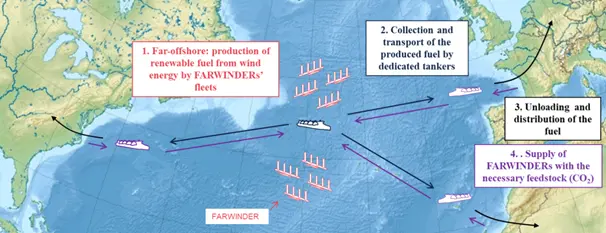
Since 2016, the EMO team at the LHEEA laboratory has been working on a new concept in marine renewable energy for harvesting wind energy on the high seas. This concept is the hydro-wind ship for hydrogen production (Platzer et al., 2014). It consists of a wind-powered ship with a hydrogenerator attached underneath. The electricity produced by the hydrogenerator is converted into hydrogen for storage on board. When the storage tanks are full, the ship sails to a terminal on land where the hydrogen is unloaded. It then returns to the open sea for a new charging cycle.
The concept of the hydro-wind ship was patented in 1982 (Salomon, 1982). However, it has been the subject of very few scientific and technical studies (Pelz et al., 2016; Kim & Park, 2010; Tsujimoto et al., 2009; Ouchi & Henzie, 2017; Gilloteaux & Babarit, 2017). All of this work has been carried out over the last ten years. The hydro-wind ship is therefore a highly innovative subject, whose technological maturity level is currently only TRL 2, or “Technology concept formulated.” The next step in the development of the hydro-wind ship concept for hydrogen production is to reach TRL 3, or “Experimental proof of concept.” This is the overall objective of the WEREVER_DEMO project, of which this WEREVER_DEMO_PLATFORM project is a part.
Scientific breakthroughs and innovation
The experimental platform developed in the WEREVER_DEMO_PLATFORM project is the world’s first testing facility for the experimental validation of wind energy recovery on the high seas using sail-powered hydrofoils.
Expected technical and economic impact
The autonomous hydro-wind ship for hydrogen production is a new concept for recovering wind energy on the high seas. It consists of a wind-powered ship with a hydro-generator attached underneath. The electricity produced by the hydro-generator is converted into hydrogen for storage on board. The stored energy is transported to an onshore terminal by specialized tankers.
The hydro-wind ship concept has great potential because it would enable the recovery of wind energy on the high seas, which represents a considerable and currently untapped source of renewable energy.
The hydro-wind ship complements fixed or floating wind turbines connected to the grid. Unlike the hydro-wind ship, it is not feasible to deploy these turbines on the high seas due to the cost of connection and anchoring. In addition, a distinctive feature of the hydro-wind ship compared to conventional wind turbines is that it is mobile. The ship’s route can therefore be optimized using weather routing so that it always sails in favorable wind conditions. This could result in a significantly higher load factor than for other renewable energy sources.
The equipment purchased as part of the WEREVER_DEMO_PLATFORM project will enable the creation of an experimental testing platform for hydro-wind ship components and systems. It will be used in particular as part of a thesis currently being supervised jointly by LHEEA and IREENA, then as part of the European FARWIND project (currently being submitted), and subsequently in other projects.
Furthermore, the expected impact of the WEREVER_DEMO project in terms of visibility, academic influence, and national and international positioning is significant for the Ecole Centrale de Nantes.
Results
A used Hobie Cat Tiger (5.5m sports catamaran) was purchased as a starting point for the development of the platform. This platform corresponds approximately to a 1/14 scale version of the demonstrator currently being considered.
The water turbine and power electronics were purchased from Efficiensea. The power electronics were specially developed for the platform.
Other sensors include an ultrasonic anemometer, two ultrasonic velocimeters (one in each hull), an IMU, a mast angle sensor, and a force sensor. The force sensor was developed in-house, while the other sensors were purchased from suppliers.
The data acquisition system was developed in-house. It includes the ability to transmit measurements remotely (via Wi-Fi).
The equipment was installed on the platform in spring 2019.
The FARWINDER-a experimental platform
Two test campaigns were carried out on May 7, 2019, and July 5, 2019, on the Erdre River in the Mazerolles plain. The results have been analyzed. They validate:
- The operating principle of the hydro-turbine sailboat.
- Energy production is significant and consistent with modeling results (75W at force 2, corresponding to approximately 800 kW at force 5 at full scale).
- The drag induced by the hydrogenerator is a key parameter for maximizing energy production (see figure below).

Left: The FARWINDER experimental platform. Right: measurements of energy production as a function of the hydrogenerator drag coefficient.
Publications and presentations produced
Oral presentations
- Validation expérimentale du principe du voilier-hydrolienne pour la récupération de l’énergie du vent en haute mer. Babarit, N. Abdul-Ghani, E. Brouillette, S. Delvoye, M. Weber, A. Merrien, J. Templai, V. Frémont, M. Michou, S. Bourguet, J-C. Gilloteaux. Journées de l’hydrodynamique 2020, 24/26 novembre 2020, En ligne
- Experimental validation of the energy ship concept for far-offshore wind energy conversion. Babarit, N. Abdul-Ghani, E. Brouillette, S. Delvoye, M. Weber, A. Merrien, J. Templai, V. Frémont, M. Michou, S. Bourguet, J-C. Gilloteaux. Ocean engineering (in preparation 2021)
Perspectives
Work continues on the WEAMEC AUTOFLEET_Y1 et AUTOFLEET_PLUS projects.